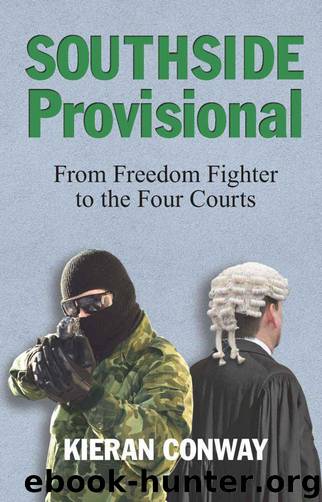
Southside Provisional: From Freedom Fighter to the Four Courts by Conway Kieran
Author:Conway, Kieran [Conway, Kieran]
Language: eng
Format: epub
Publisher: Orpen Press
Published: 2014-11-19T23:00:00+00:00
Chapter 10
The summer of 1972 was truly historic, bringing as it did the truce, its breakdown, the continuing rise of the UDA, the Bloody Friday bombings and Operation Motorman. The republican refusal to respond to the imposition of direct rule had produced a fledgling peace movement which contributed to the existing pressures on the leadership, particularly on Seán MacStiofáin, who was depicted as living with his wife and family in easy distance from the violence.
In response to intermediaries, the IRA held a press conference in Free Derry in early June. This was attended by MacStiofáin and O’Connell (on behalf of the leadership), and Seamus Twomey and Martin McGuinness (the then O/Cs in Belfast and Derry respectively) to offer peace talks, thereby – it was hoped – putting the political pressure back on the British. The offer this time was for a suspension of operations for a seven-day period, provided Whitelaw agreed to meet the peace plan first announced in March. Though Whitelaw turned this down within hours, behind-the-scene contacts resulted in a secret meeting between British representatives, Dave O’Connell, and Gerry Adams. I later heard that Adams had been especially released from internment for that purpose at Dave’s insistence.9 These discussions led to the truce and the first negotiations between the British government and the republican leadership since 1921.
Our proposals were put directly to Whitelaw at a meeting in London attended by the same leaders who had been at the Derry press conference, together with Ivor Bell and Gerry Adams. Adams and Bell were both then part of the Belfast leadership and the fact that no less than three Belfast Brigade members were present testifies to the then primacy of Belfast within the IRA. The proposals, which were non-negotiable, were for a public recognition by the British government of the right of the Irish people acting as a single unit to decide the future of Ireland, a declaration of intent to withdraw troops from certain areas immediately and to be out of the North altogether by 1 January 1975, and an amnesty for all political prisoners – proposals that Whitelaw undertook to take to Heath and his cabinet.
Back in Belfast UDA barricades were in place, and Catholics who came across them were in serious trouble, getting badly beaten and occasionally shot dead. Six died at the hands of loyalists during the fourteen-day truce. By now the patterns were clear, with drive-by shootings taking place on Catholic streets and outside houses and shops where the killers could be pretty certain the victim would be a Catholic. The killings naturally terrified the Catholic population. Worse than being shot dead, though, was the thought of falling into the hands of the killers, as had many of these young men. To be despatched quickly by gunfire was one thing, but given that the purpose of loyalist terror was to terrorise, there was a sort of logic to their stepping it up to torturing their victims. In a ghoulish instance of loyalist humour, the torture
Download
This site does not store any files on its server. We only index and link to content provided by other sites. Please contact the content providers to delete copyright contents if any and email us, we'll remove relevant links or contents immediately.
| Anthropology | Archaeology |
| Philosophy | Politics & Government |
| Social Sciences | Sociology |
| Women's Studies |
The Secret History by Donna Tartt(19098)
The Social Justice Warrior Handbook by Lisa De Pasquale(12195)
Thirteen Reasons Why by Jay Asher(8917)
This Is How You Lose Her by Junot Diaz(6892)
Weapons of Math Destruction by Cathy O'Neil(6283)
Zero to One by Peter Thiel(5806)
Beartown by Fredrik Backman(5763)
The Myth of the Strong Leader by Archie Brown(5511)
The Fire Next Time by James Baldwin(5452)
How Democracies Die by Steven Levitsky & Daniel Ziblatt(5223)
Promise Me, Dad by Joe Biden(5156)
Stone's Rules by Roger Stone(5089)
A Higher Loyalty: Truth, Lies, and Leadership by James Comey(4965)
100 Deadly Skills by Clint Emerson(4929)
Rise and Kill First by Ronen Bergman(4796)
Secrecy World by Jake Bernstein(4755)
The David Icke Guide to the Global Conspiracy (and how to end it) by David Icke(4721)
The Farm by Tom Rob Smith(4516)
The Doomsday Machine by Daniel Ellsberg(4492)
